
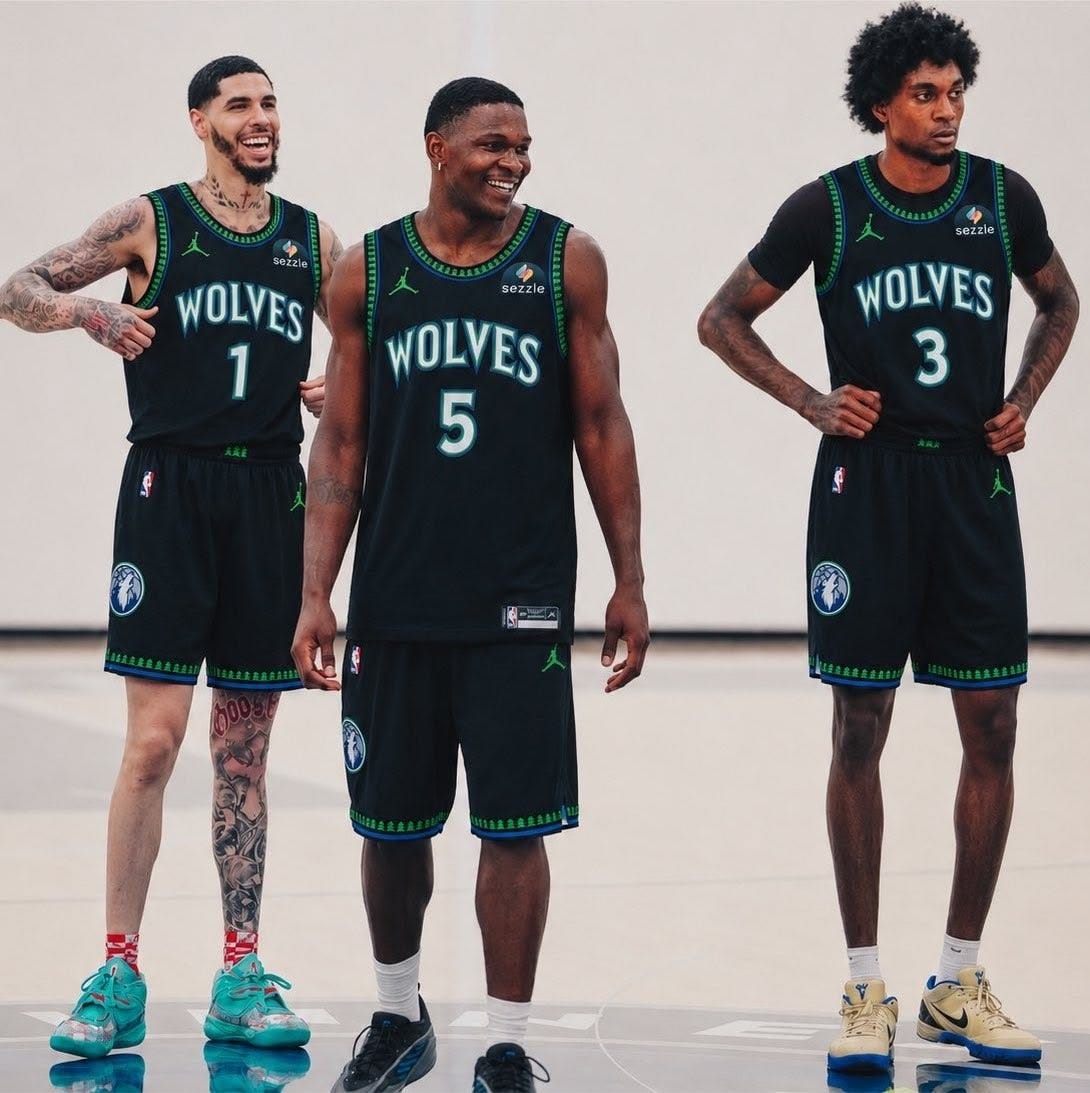
A three-season analysis of Minnesota’s offense, defense, playoff performance, Anthony Edwards’ offensive burden, and the potential impact of LaMelo Ball
Why Can’t Minnesota Get Over the Hump?
Minnesota’s recent history presents an interesting contradiction.
From an optimistic perspective, the Timberwolves have established themselves as one of the Western Conference’s strongest teams. Their 2023–24 and 2024–25 seasons ended with Western Conference Finals appearances, demonstrating that the core of this team is capable of competing deep into the postseason.
But the 2025–26 season exposed a different side of Minnesota.
The Timberwolves failed to return to the Western Conference Finals, instead exiting in the Conference Semifinals. More importantly, their offensive performance declined, raising a larger question:
What is preventing Minnesota from turning repeated playoff success into genuine championship contention?
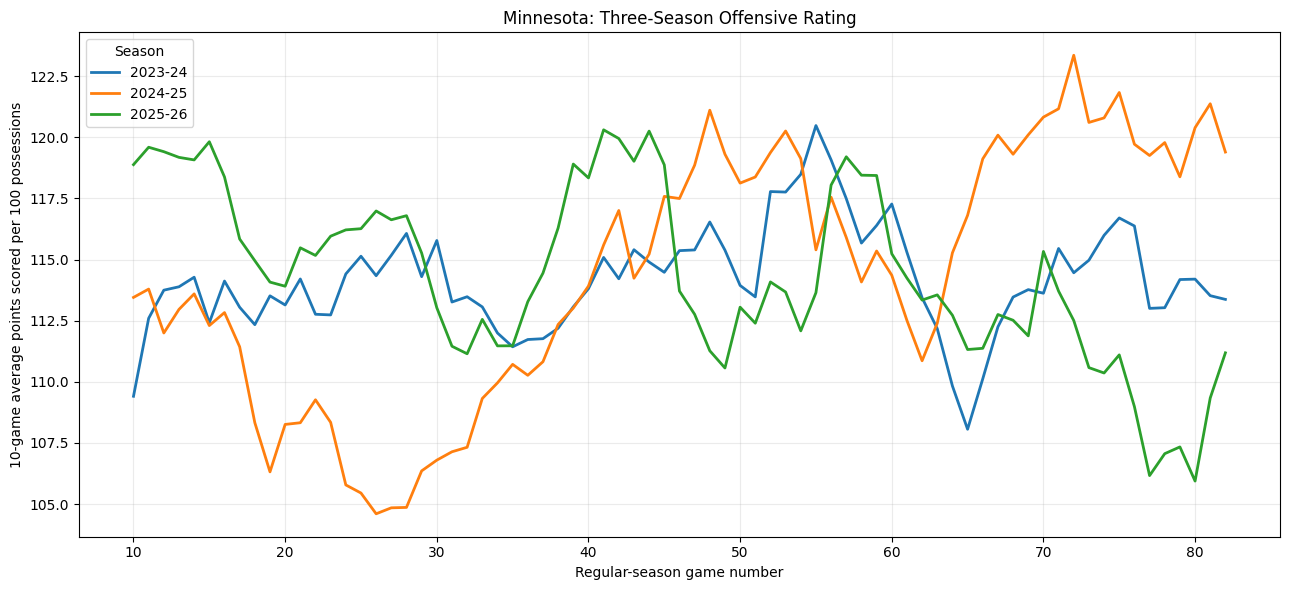
Minnesota’s offensive rating showed several noticeable declines throughout the 2025–26 regular season. One of the sharpest occurred around games 70–80, coinciding with Anthony Edwards’ absence. Similar declines can be observed around other stretches in which Edwards was unavailable, highlighting how strongly Minnesota’s offense was tied to his presence.
The story was different on the defensive end. Minnesota maintained one of the league’s strongest defenses throughout the regular season, finishing with the second-best defensive rating in the league, behind Denver
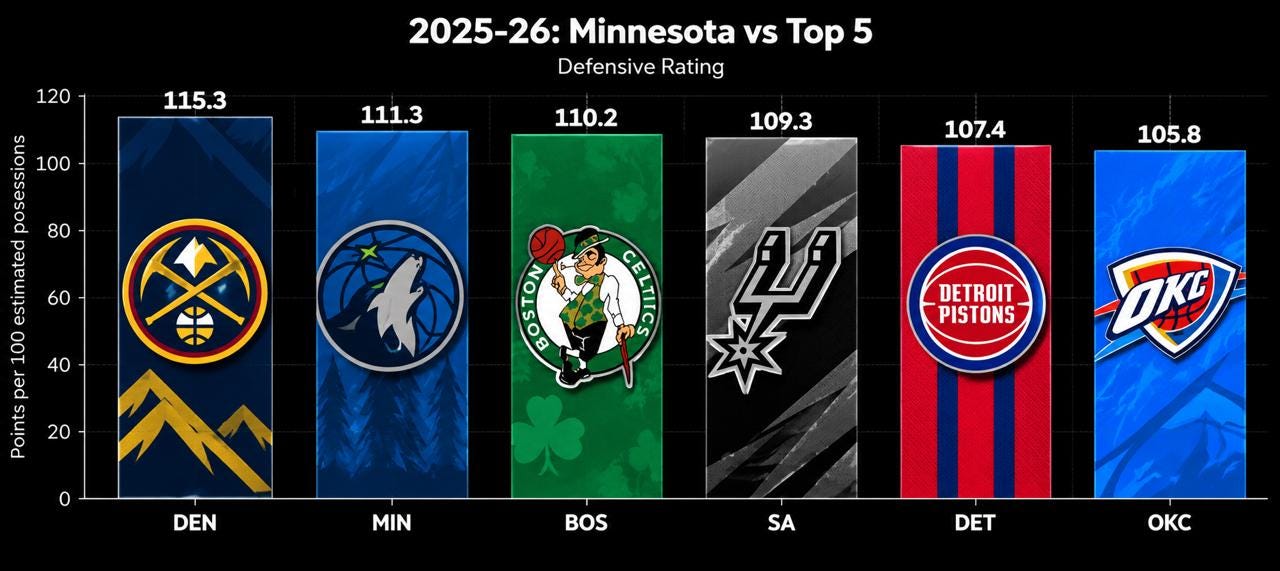
.Despite maintaining one of the league’s strongest defenses, Minnesota finished the regular season with a +3.1 net rating — well below the roughly +8 average of the league’s top five teams. The gap highlights the central problem facing the Timberwolves: their defense was good enough to compete with elite teams, but their offense wasn’t consistently strong enough to match them.
When the Offense Matters Most
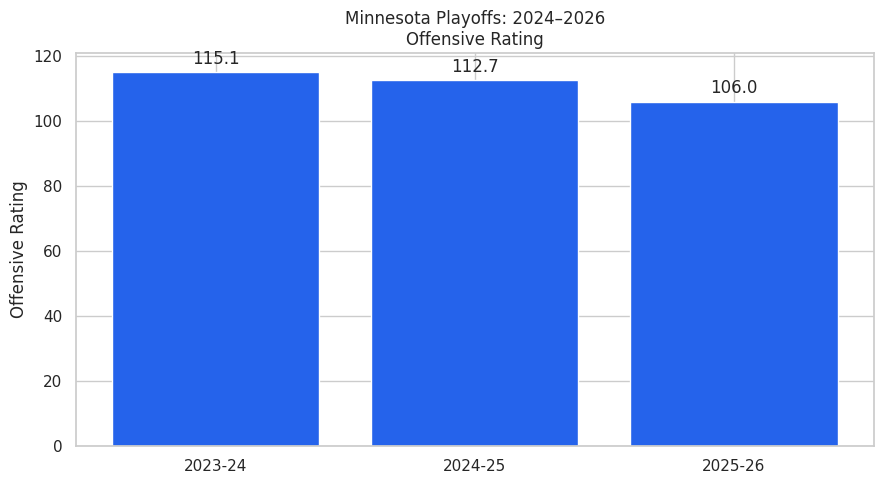
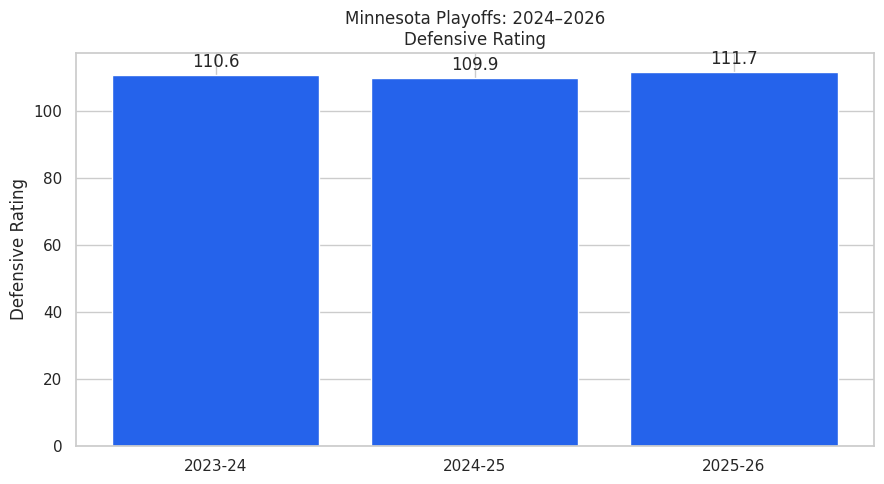
Minnesota’s playoff offense has declined across each of the past three seasons. In 2025–26, the Timberwolves recorded their lowest playoff offensive rating of the three-year sample at 106.0. At the same time, their defense was actually at its strongest, posting a 111.7 defensive rating.
The Pace Wasn’t the Problem
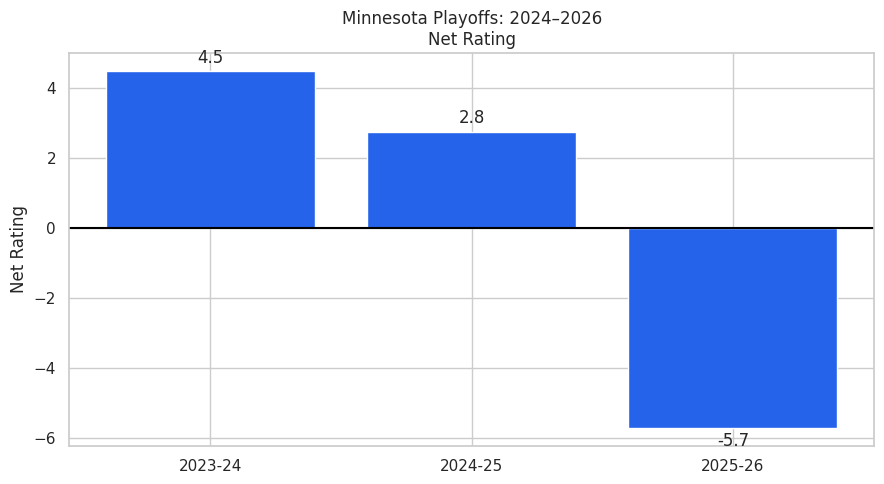
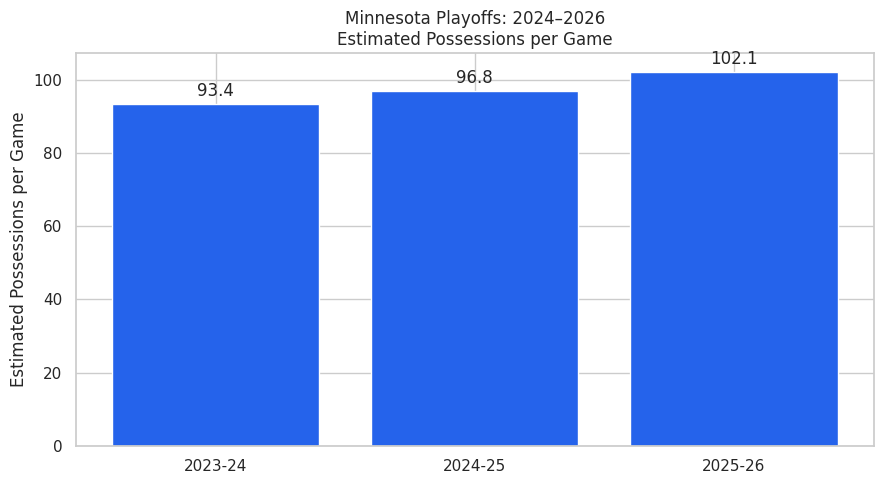
Minnesota’s offensive struggles were not simply a result of playing at a slower pace. In 2025–26, the Timberwolves averaged an estimated 102.1 possessions per game, their highest mark across the three-season playoff sample. Yet their net rating fell to −5.1, the team’s first negative playoff net rating in the period.
The combination points toward a more specific problem: Minnesota was getting enough possessions, but wasn’t converting them into enough efficient offense.
Minnesota vs the Conference’s Best
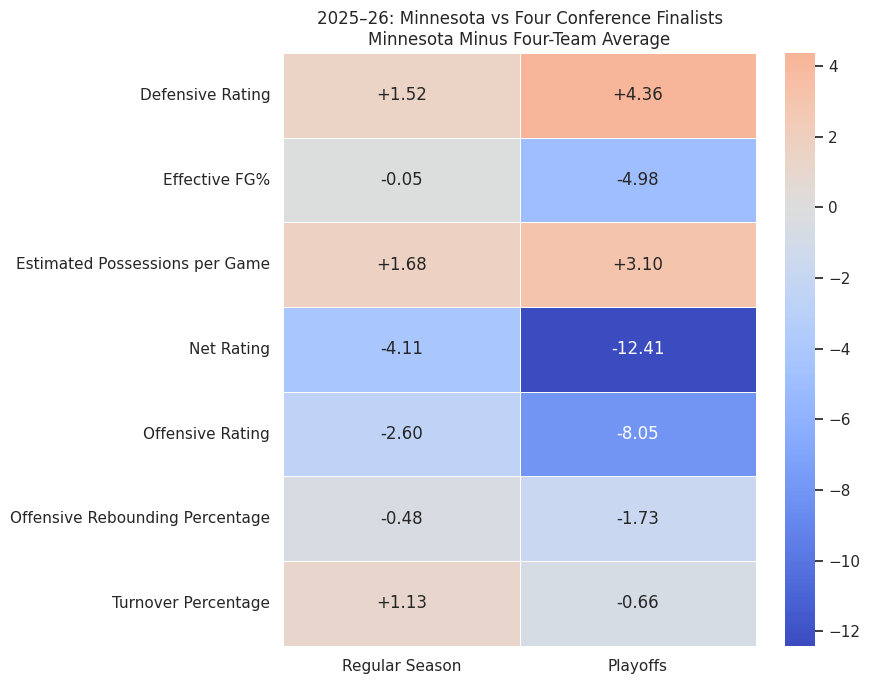
The difference becomes even clearer when Minnesota is compared with the four conference finalists in our comparison group: New York, Cleveland, Oklahoma City and San Antonio.
Minnesota ranked last in offensive rating among the five teams and second in defensive rating. They also posted the lowest effective field-goal percentage, despite operating at a similar possession level to the rest of the group.
The pattern is difficult to ignore: Minnesota’s defense was competitive with the league’s best teams, but its offense and shooting efficiency lagged behind.
How Much Does Minnesota Rely on Edwards?
Anthony Edwards played in 61 of Minnesota’s 82 regular-season games, with the Timberwolves going 21 games without him. In the playoffs, he appeared in 10 games and missed 2.
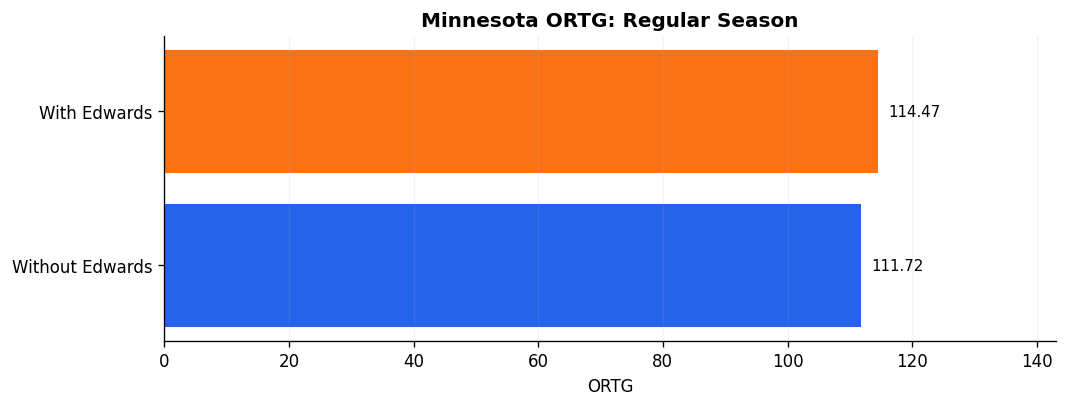
When Edwards played during the regular season, Minnesota posted a 114.47 offensive rating, compared with 111.72 when he was absent. His presence therefore clearly coincided with a more productive offense.
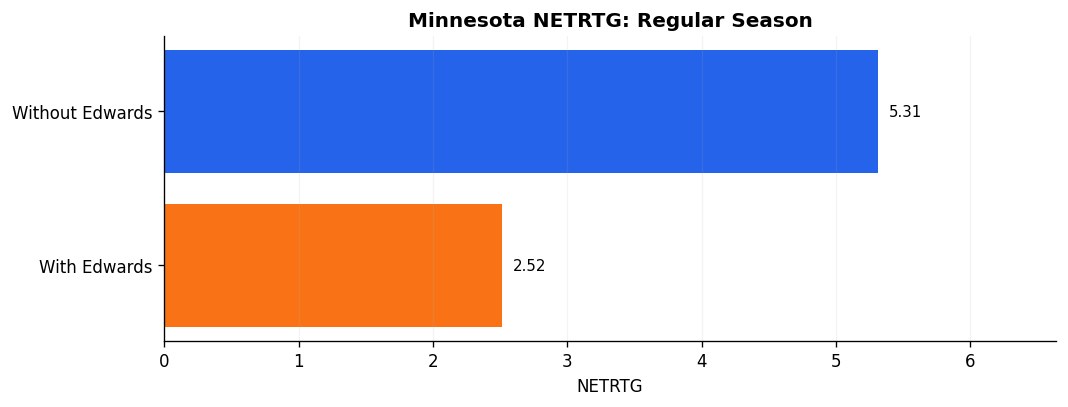
However, the net-rating numbers tell a more complicated story. Minnesota recorded a +2.52 net rating with Edwards compared with +5.31 without him
.The Playoff Sample Tells a Different Story
The 2025–26 playoffs produce an even more striking split.
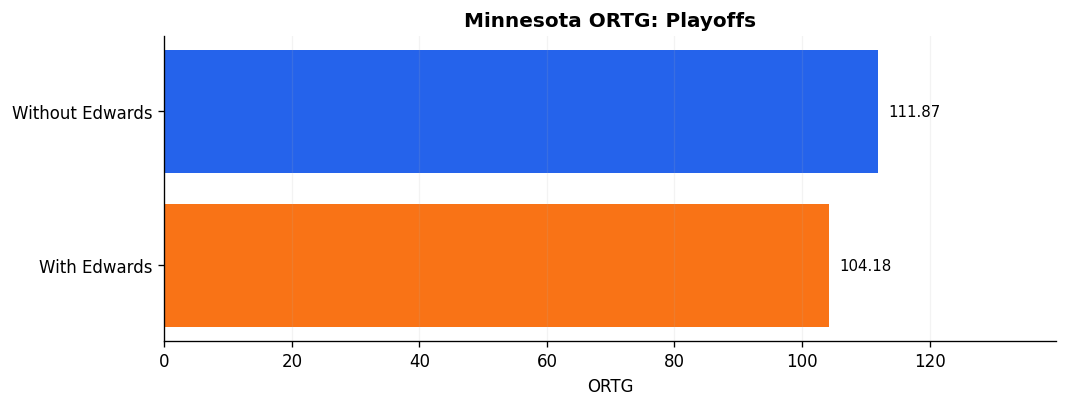
Minnesota recorded a −5.7 net rating with Edwards compared with 0.00 without him, while also posting a higher offensive rating in the two games he missed.
But this comparison should not be interpreted as evidence that Minnesota performed better without Edwards. Edwards missed only two playoff games, making the sample far too small for a meaningful on/off conclusion.
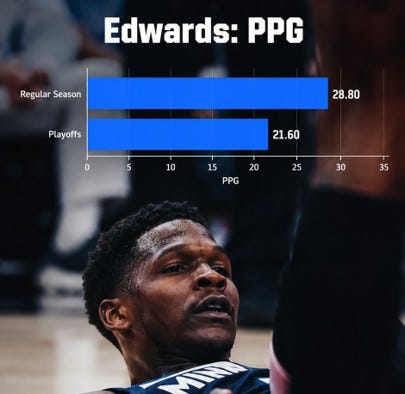
Edwards was Minnesota’s leading scorer during the regular season, averaging 28.8 points per game. That figure fell sharply to 21.5 PPG in the playoffs.
A decline of more than seven points per game from the team’s primary scorer is significant, particularly for an offense that already ranked poorly among the teams in our comparison group.
There are several possible explanations for the decline. Edwards was also dealing with a left knee injury during the postseason, which provides a potential explanation for part of the decline. He also attracted substantial defensive attention throughout the season; according to the All City NBA data used in this analysis, he faced double-teams on approximately 20% of his touches.
Does Minnesota Have a Playmaking Problem?
Minnesota’s offensive creation wasn’t solely dependent on Edwards. The team had several players capable of facilitating the offense, but the distribution of that responsibility was unusual.
Mike Conley, Minnesota’s nominal point guard, averaged just 5.1 potential assists per game during the regular season. Instead, Julius Randle emerged as one of the team’s primary secondary creators, averaging 8.7 potential assists and 5.0 assists per game
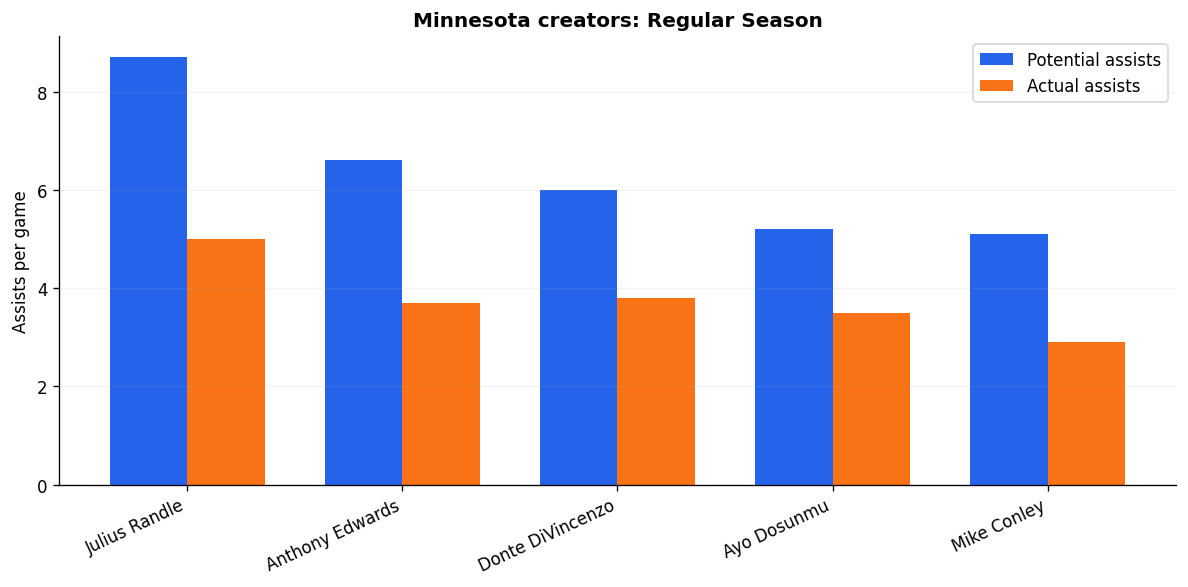
.This doesn’t necessarily mean Conley was ineffective. Rather, it highlights how much of Minnesota’s playmaking responsibility was being handled by players who were not traditional high-volume primary point guards.
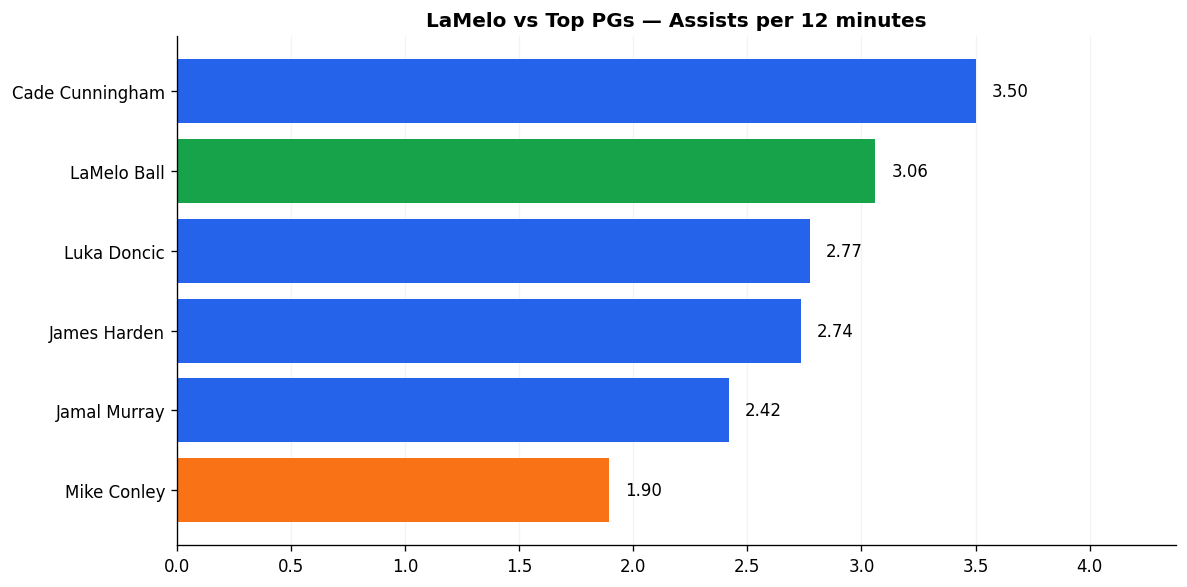
Conley did increase his playmaking output in the playoffs, generating 2.27 assists per 12 minutes. However, that improvement still wasn’t enough to compensate for Minnesota’s broader offensive struggles.
The LaMelo Ball Addition
If Minnesota’s biggest offensive issue is the lack of another high-level creator alongside Edwards, LaMelo Ball presents an interesting potential solution.
LaMelo averaged 20.1 PPG, 4.8 RPG and 7.1 APG during the regular season, while generating 11.6 potential assists per game. The potential-assist figure is particularly relevant to Minnesota because it measures the volume of scoring opportunities a player creates for teammates, rather than only the assists that ultimately become made baskets.
LaMelo’s playing time was relatively limited at 28.0 minutes per game, so looking at his production on a per-12-minute basis provides another way to compare his creation volume with other high-level guards. On that basis, he generated 3.05 assists and 4.97 potential assists per 12 minutes, ranking behind only Cade Cunningham among the players in our comparison.
But LaMelo’s value isn’t limited to passing.
He also provides significant perimeter volume. He made 272 three-pointers during the season — just one fewer than teammate Kon Knueppel, despite playing nine fewer games. His 740 three-point attempts also underline how consistently he is willing to stretch the defense from deep.
That volume becomes even more interesting when combined with his pull-up shooting. LaMelo attempted 5.6 pull-up threes per game and converted them at 36.8%, the highest pull-up three-point percentage among the players in our comparison group
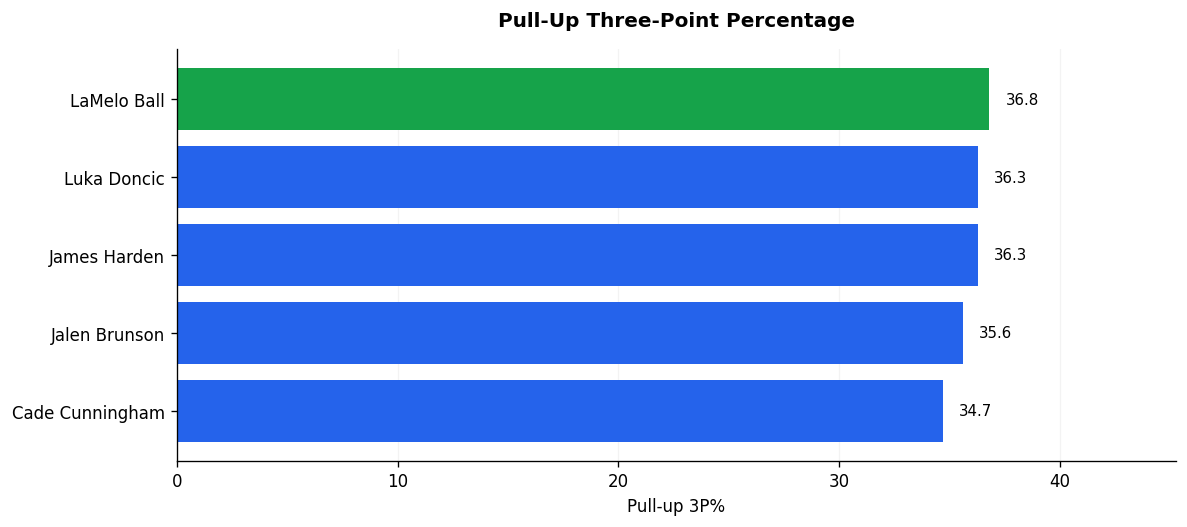
.For Minnesota, this creates a potentially important combination: another player who can initiate the offense, create opportunities for teammates and generate high-volume three-point attempts without needing Edwards to create every possession.
Modeling LaMelo’s Offensive Impact
We built a scenario-based model using Minnesota’s 2025–26 offense and LaMelo’s scoring, playmaking and shooting profile. The model tested 27 workload scenarios followed by 10,000 Monte Carlo simulations, varying LaMelo’s minutes, offensive workload and where that workload would come from.
In the base case, LaMelo projects to approximately 21.5 PPG, 7.6 APG and 11.0 3PA, while Minnesota gains roughly +13 PPG, +5 APG and +7 3PA in net offensive impact
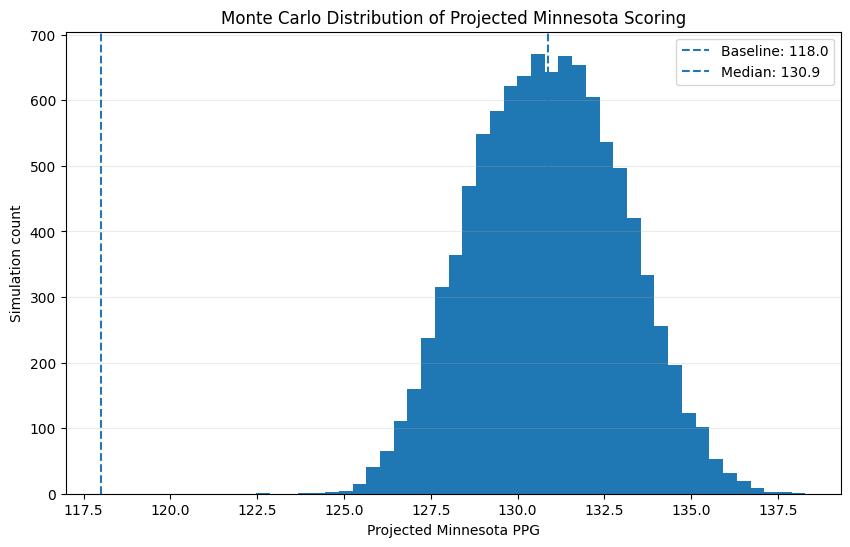
.The key takeaway isn’t simply more scoring. The model suggests that LaMelo could give Minnesota a
second high-level offensive creator, diversify its attack and reduce the burden on Anthony Edwards.
Can LaMelo Move Minnesota Into Contender Territory?
To measure whether LaMelo’s projected offensive impact could translate into a stronger team, we modeled Minnesota’s competitive outlook using SRS, roster-adjustment scenarios and season simulations.
Minnesota’s baseline 3.07 SRS was tested under three scenarios: Conservative (+1.5), Base (+2.5) and Aggressive (+4.0). This moved Minnesota to approximately 4.57, 5.57 and 7.07 SRS, respectively
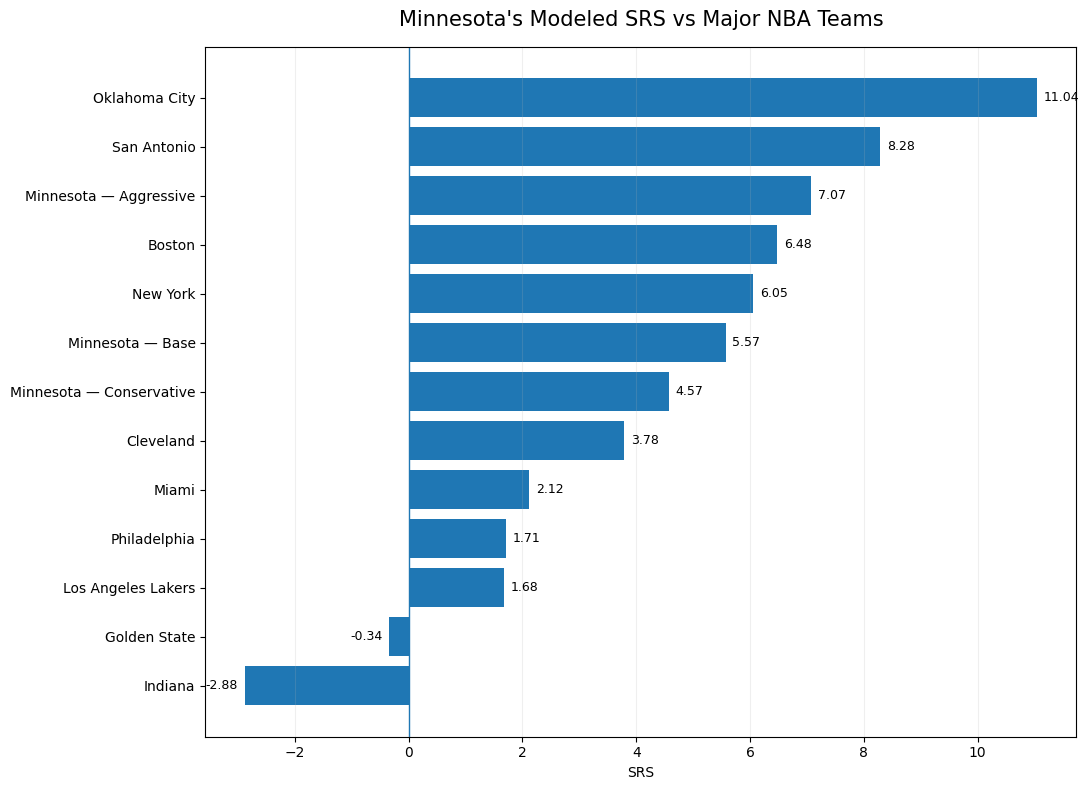
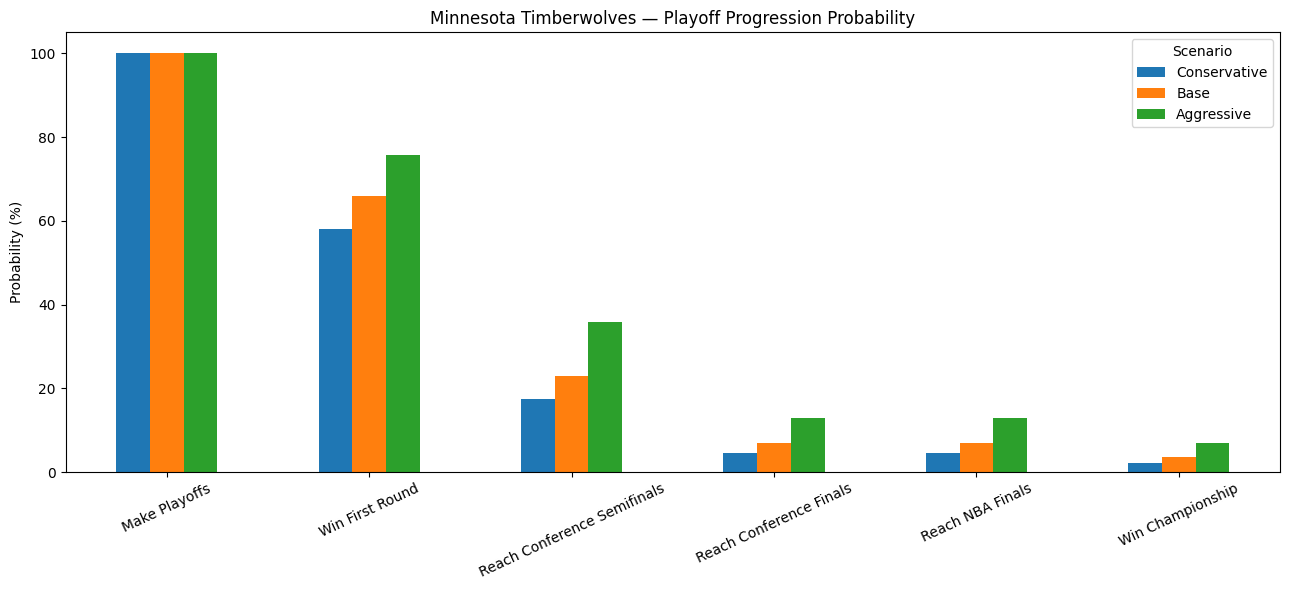
The base scenario places Minnesota closer to the league’s stronger teams, with an estimated 53–54 wins over an 82-game season. Across the playoff simulations, Minnesota’s probability of winning the first round increased from 58.1% in the Conservative scenario to 75.6% in the Aggressive scenario.
The model suggests that LaMelo could move Minnesota from a solid playoff team toward the legitimate contender tier. However, the improvement does not eliminate the team’s remaining weaknesses or make them an automatic championship favorite.
Conclusion — What Changes With LaMelo?
Minnesota’s recent playoff struggles are not primarily a story of defensive failure. The Timberwolves have consistently maintained a strong defensive foundation, but their postseason offense has declined over the three-season sample.
The bigger issue is offensive creation. Anthony Edwards remains Minnesota’s primary offensive engine, while the supporting cast has not consistently provided another high-volume creator capable of taking pressure away from him when playoff defenses tighten.
LaMelo Ball directly addresses that weakness. His combination of 7.1 APG, 11.5 potential APG, high-volume three-point shooting and pull-up scoring gives Minnesota another player capable of creating offense independently.
Our modeling suggests that his addition could raise Minnesota from a solid playoff team toward the legitimate contender tier. It does not eliminate every weakness or guarantee a championship, but it could fundamentally change how Minnesota generates offense.
The question was never whether Anthony Edwards is good enough. It was whether Minnesota could build enough around him. LaMelo gives them another answer.